Summary
The Biodiversity Monitor for dairy farming is a result-based methodology, with a primary focus on the public good biodiversity (including strong links with soils, landscape, environment and climate). The aim of the methodology is to make biodiversity-enhancing performance per dairy farm measurable. In this way we can benchmark farms and allow multiple stakeholders to reward positive biodiversity performance. These stacked financial rewards should lead to new revenue models for ecosystem-based dairy farming. As a consequence, it will stimulate farmers towards more sustainable production practices. The methodology is developed by WWF-NL, Rabobank and Duurzame Zuivelketen (sustainable dairy initiative); in collaboration with scientists, experts, and stakeholders. FrieslandCampina is an important stakeholder, which was involved in the prototype development, and has used the methodology since 2018 to reward farmers. The biodiversity-enhancing performance per dairy farm is measured with an integrated set of seven Key Performance Indicators (KPIs): permanent grassland (%), protein from own farm/region (%), soil nitrogen surplus (kg/ha), ammonia emissions (kg/ha), greenhouse gas emissions (kg/ha and kg/kg milk), herb-rich grassland (%) and nature conservation management & landscape elements (%). These KPIs are selected based on multiple criteria, including their scientifically proven relation with biodiversity, and that performance can be influenced in the short term by taking measures on the farm. For all KPIs, scientists determine threshold- and target values based on existing legislation and policies, and best available scientific knowledge. Good performance on the integrated set of KPIs can be linked with financial rewards from multiple stakeholders. Note that the Biodiversity Monitor provides a scientifically substantiated methodology to measure biodiversity-enhancing performance per farm, while contracting parties who use this data are free to decide how they reward the farmer. Currently, the Biodiversity Monitor is used in 2 private-private contract mechanisms (by FrieslandCampina and Rabobank) and 1 private-public contract mechanism (by province Drenthe) to reward and stimulate ecosystem-based dairy farming. FrieslandCampina incorporated the integrated set of KPIs in their sustainability monitoring program, Foqus planet. All farmers can be rewarded for KPI performance improvements over time; and the best performing dairy farmers who comply with the certification standards of ‘On the way to PlanetProof dairy’ (which includes the KPIs), receive a higher milk price. Rabobank is piloting with green financing funding to reward farmers with a loan interest discount. Drenthe runs a program which grants financial rewards to good performing local farmers. The methodology can be used in multiple other contracts, and there is much potential for integrating it in the new Common Agricultural Policy (CAP). The aim is to involve more rewarding parties (e.g. businesses, banks, land leaseholders, water boards, governments) to use the biodiversity monitor to reward ecosystem-based dairy production.
Objectives
The objective of the Biodiversity Monitor is to make biodiversity-enhancing performances per dairy farm measurable. This allows multiple stakeholders to financially reward positive biodiversity impacts based on unambiguous scientifically relevant results. The stacked financial rewards from multiple stakeholders, based on the same KPIs, stimulates farmer incentive for ecosystembased dairy farming. In this way, the Biodiversity Monitor stimulates the transition towards more sustainable production while enhancing biodiversity recovery, additional farmer income, and a future perspective for the dairy sector.
Data and Facts - Contract
(In)direct effects: TThe primary focus is on (farmland) biodiversity, with strong links to soil quality and health, climate regulation (carbon storage and greenhouse gas emissions), and landscape and scenery. Indirect beneficial effects are on air quality (e.g. less ammonia emissions), recreational access (improved landscape quality), resilience to natural hazards (improved soil health), rural viability and vitality (increased farmer income and social appreciation), farm animal health and welfare (more grazing), and water quality (less soil-N surplus).
Involved parties: The initiators of the biodiversity monitor for dairy farming are WWF-NL, Rabobank and FrieslandCampina. Duurzame Zuivelketen, the sustainable dairy chain initiative for a responsible future-proof sector, later substituted FrieslandCampina in order to increase commitment of the wider dairy sector. These parties together developed the biodiversity monitor in close collaboration with researchers from Wageningen University & Research and the Louis Bolk Institute. During the development process (2014-ongoing) farmer organizations have continuously been consulted, pilots have been undertaken, and multiple stakeholder meetings took place. Since 2020, the Biodiversity Monitor Foundation manages the methodology development, monitoring and evaluation. Current contracting parties are FrieslandCampina, Rabobank and province Drenthe. In the future, many other stakeholders can also become contracting party.
Participation: FrieslandCampina is a dairy cooperative with >11.000 farms who are currently all obliged to participate in the sustainability monitoring program Foqus planet. Amongst other indicators for milk quality and animal welfare, this program also includes all seven KPIs to measure biodiversity impacts. Farms can receive a higher milk price for good performance and an extra bonus for improvements over time on the sustainability indicators. Besides, the best performing dairy farms which comply with the certification standards of ‘On the way to PlanetProof dairy’ (which includes the KPIs), receive an even higher milk price. Currently (Jan. 2019), about 600 farms are certified. These farms are spread throughout the Netherlands. Together with FrieslandCampina and Province Drenthe, Rabobank runs a pilot with Green bonds, which currently includes about 15 dairy farms and can grow to 50 farms in total. Farms with a good score on all KPIs or a PlanetProof certification can receive a loan interest discount. The ambition is to implement this nationally in the future. Province Drenthe currently runs a program to financially rewards 250 local dairy farms which score well on KPIs.
Advantage for involved parties
- Dairy farmer: financial support for biodiversity-enhancing efforts, what contributes to a better business model for ecosystem-based dairy farming.
- FrieslandCampina: sustainable dairy supply chain (future-proof), and safeguard of societal support for the sector (license to produce).
- Rabobank: financial risks minimalization, a sustainable perspective (future-proof), and a corporate responsible image.
- Assumed advantages for other potential contracting parties: sustainable soil management (land leaseholders), improved water quality (water boards), and enhanced conservation of nature reserves, ecosystem services and landscape quality (governments).
Funding/ Payments
- By Rabobank: The interest loan discount can be granted at moments of refinancing or at the start of a new contract. The discount can be max. 0,5% on a loan of max. 1 million euros (so max. 5.000 euros per year), for a contract period of max. 5 years. When the contract duration is shorter, then the discount also decreases. In the future, Rabobank aims to standardize all contracts at 0,4% for all contract durations, in order to simplify the system. Rabobank retrieved this money from own resources.
- By FrieslandCampina: Rewards for good performance in Foqus planet are retrieved from a redistribution of the cooperative's milk revenues. Instead of a fixed milk price for all farms, now the milk price is determined per dairy farm based on its performance. The best performing farmers can receive max. 0,20 cents extra per 100 kg milk. Besides, farms can receive an extra bonus for improvements over time on the sustainability indicators of max. 0,29 cents per 100 kg milk. At last, milk certified as ‘On the way to PlanetProof’ is rewarded with a higher milk price of 2 euro extra per 100 kg milk (Jan. 2020).
- By Province Drenthe: Drenthe provides farms an annual amount of max 2.500 euro (depending on performance), for max. 3 year. Besides, farms can count on about 1.500 euro per farm (only once) for education and consult about sustainable farm management. This money comes from provincial budgets to stimulate sustainable farming.
Controls/monitoring: The Biodiversity Monitor Foundation manages the methodology development and is responsible for data monitoring and evaluation. Independent data quality assurance is executed by a third party (Qlip). Most KPI data are obtained and calculated into scores within the program Kringloopwijzer – a farm management tool which dairy farms are obliged to use. Data about the KPI Herb-rich grassland and KPI Nature & landscape elements are not registered in Kringloopwijzer. Currently, the data from the Agricultural Nature and Landscape Management (ANLb; CAP 2) schemes are used for those farmers involved in this program. Simultaneously, a national registration system is being build in order to gather and monitor data on these KPIs for all Dutch dairy farms.
Conditions of participation: All contracting (rewarding) parties use the Biodiversity Monitor KPIs to determine contract qualifications. Contracting parties can determine their own contract conditions, and are free to determine goals per KPI and the extend of rewards per farm. For example Rabobank determined the top 25% dairy farms with best scores on all KPIs as eligible for a loan interest discount. FrieslandCampina used the roughly top 10% .
Risk/uncertainties of participants: Current reward are only for short period of time (contract length) – no longer term rewarding guaranties are provided.
Problem description
The Netherlands are among the worst performers in Europe when it comes to protecting biodiversity. Populations of wild animals in the agricultural landscape decreased by 50% since 1990 (WWF-NL, 2020). These massive losses for nature are largely related to increased intensification and scale of agricultural production systems over the past decades.
With a 30% land share (CBS, 2019), the dairy sector is one of the biggest land users of the Netherlands and puts significant pressure on biodiversity - both on farmland and on adjacent nature areas as well as in production areas of imported animal feeds (e.g. soy from Brazil). The grasslands are generally intensively managed with monoculture crops (perennial ryegrass), early mowing, fertilizers and herbicides. This type of management threatens grassland species such as meadow birds, which suffer from the mowing during breeding season and limited availability of herbs and insect to feed the chicks. Most non-agricultural landscape elements, such as hedges and flowery corners, have disappeared during land consolidation processes for grassland scaling. This leaves less and less space for birds, butterflies, and other animals to forage, seek shelter and nest. Moreover, the quality of these habitats declines due to environmental pollution caused by agricultural activities. Especially nitrogen deposition and leaching causes eutrophication of soils and water, leading to losses of plant species and life in freshwater. Herbicides sprayed on grass are generally harmful for soil life and insects. All these practices together affect the entire food-web, leading to the massive loss of biodiversity in the agricultural landscape and beyond.
Changes in farming practices are urgently needed to stop and reverse biodiversity losses, but also to ensure the continuation of agricultural production which depends on ecosystem services (e.g. clean water and healthy soils). However, current markets provide small margins on milk, resulting in low farmers’ income what stimulated intensification even further.
In order to create a future perspective for nature and dairy farmers, new business models are required to make ecosystem-based dairy farming a sustainable, profitable and attractive practice for farmers. In the light of that challenge, the Biodiversity Monitor for dairy farming has been established by a multi-stakeholder coalition consisting of WWF-Netherlands, Duurzame Zuivelketen (including FrieslandCampina – the largest dairy cooperative in NL with >19k members spread over >11k farms) and Rabobank (largest agricultural financer in NL).
Context features
Landscape and climate: The geography of the Netherlands can roughly be split into two areas: the low and flat lands in the West and North, and the higher lands with some hills (max. 300 meter) in the East and South. Much of the lower lands have been reclaimed from the sea (polders) and are below sea level, protected by dikes. The water is continuously pumped away through many small canals, and the groundwater level is in most places regulated at low levels. Soils in the lower lands are predominantly peat and loam, while the higher lands are more sandy-peat, sand and clay. The Netherlands have a temperate maritime climate, with cool summers (average daytime temperatures varies from 17-20 °C) and moderate winters (2-6 °C).
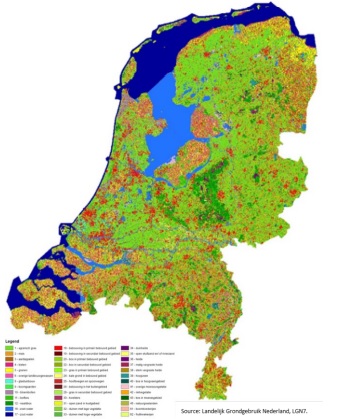
Farm system: The Netherlands is for 44% covered with agricultural land (1,82 million ha, out of the total country area of 4,15 million ha), which is for more than half in use as grassland (0.98 million ha – 24% of the country, 30% of total land area, and 54% of total agricultural area; CBS, 2019). See the light green areas on the map here at the right (number 1 in legend).
Consequently, the dairy sector is the largest land user in the Netherlands. The grasslands are spread over the entire country. The grasslands are mostly used by the nearly 18.000 dairy farms for grazing and/or mowing for cattle feed, which together house a total of 1,58 million dairy cows - predominantly Holstein Friesian (CBS, 2019 ). Together they produce about 15k million liters of milk per year - what is for about 65% exported (CBS, 2016 ). An average dairy farm has about 100 cows on 54 ha for grass and silage maize (CBS, 2018) - leaving on average about 1.9 cows per ha. About 5% of the grasslands are organically managed. Most farmers work full-time. Different kinds of grassland management are executed: 70% as permanent grassland, 22% as temporary grassland, and 8% as natural/biodiverse grassland (CBS, 2019). The permanent and temporary grasslands are generally intensively managed with monoculture crops (perennial ryegrass), early mowing, fertilizers and herbicides. The natural/biodiverse grasslands are generally very extensively managed, and most farmers receive yield loss compensation from Pillar 2 CAP. Most non-agricultural landscape elements, such as hedges and herbal-rich corners, have disappeared over the past decades during land consolidation processes for grassland scaling. Consequently, very little suitable habitat is left over for wildlife – contributing substantially to the massive biodiversity losses in the agricultural area in NL (WWF-NL, 2020).
Success or Failure?
We (WWF-NL) consider the establishment of the Biodiversity Monitor for dairy farming with this multi-stakeholder coalition as a major (factor for) success. Particularly the adoption of the monitor in the sustainability programs of the two key stakeholders FrieslandCampina and Rabobank is a major step into the right direction. The Biodiversity Monitor is also acknowledged in national policies as a good and useful example to work on the dual challenge of nature restoration and future perspective for farmers within the entire agricultural sector.
Also the innovative Delta Plan for Biodiversity Recovery (an ambitious plan signed by 30+ leading Dutch agri- and horticulture retail, agro-industry, nature and environmental organizations and science institutions) embraced the Biodiversity Monitor as key methodology for monitoring and rewarding best performances. The key success factors determined by the Delta Plan for Biodiversity Recovery are: shared values, coherent laws and regulations, knowledge and innovation, collaboration at the landscape level, and new business models. The Biodiversity monitor enhances all success factors, and particularly the new business models. Provinces and businesses have shown interest to implement the monitor and reward farmers for their performance on biodiversity. In general, the Biodiversity Monitor methodology is quite innovative and widely acknowledged as a high-potential contract solution. Especially the use of KPIs to quantify impact (performance) instead of prescribing measures or best agricultural practices, is critical to enhance impactful change. The methodology has potential to be unrolled in other sectors and regions, as done now for the arable farming sector in the Netherlands (see other Console case ‘Biodiversity monitor Arable farming’). However, whether this contract solution contributes substantially to biodiversity recovery requires verification. Monitoring of the relationship between KPI performance and actual biodiversity enhancement, is scheduled for future trajectories.
SWOT analysis
Main Strengths
1. The result-based approach based on Key Performance Indicators (KPIs)2. The integrated approach (aiming for positive results on all KPIs, on each farm) is powerful to stimulate biodiversity recovery without allowance for trade-offs
3. The Biodiversity monitor will become available for all Dutch dairy farms and can be used by all relevant stakeholders for result-based financial rewards.
4. Minimal extra administrative burden as most data comes from already obliged farm management data tools.
Main Weaknesses
1. Availability and reliability of data needed to calculate the KPI performance per farm. For two KPIs, the data is not yet nationally registered and therefore only available at farms where audits have taken place. The development of a national registration system for these KPIs is currently ongoing.2. Environmental effectiveness requires verification by on-site monitoring. This is scheduled for future trajectories.
Main Opportunities
1. The Biodiversity monitor can be used in many different private-private and private-public contracts2. High potential for integration in ecoschemes for the CAP
3. Multiple stakeholders can reward farmers based on the same biodiversityenhancing results, enabling farmers to manage on clear unambiguous goals.
4. Stacking financial rewards based on the same KPIs can enhance new revenue model for ecosystem-based dairy farming.
Main Threats
1. Contracting parties can determine their own rewarding system and goals per KPI, allowing for the risk of rewarding targets below the required levels for biodiversity recovery (from ecological perspective).2. Even though this methodology is theoretically very promising, the instrument is sometimes perceived as rather complex and difficult to apply. Information exchange and practical education is essential here.
Main external factors
Political/governance, economic/market, social, technological, legal and environmental factors can all have a strong impact on the success of contract solutions. In this case study an in-depth analysis found that the following, selected factors were of specific importance.
Technological development could influence the further effectiveness and efficacy of the biodiversity monitor. Particularly digitalization, monitoring and evaluation of farm data could improve the basis for the assessment of the keyperformance indicators: for two of the seven KPI so far no nation-wide data registration system is available. For herb-rich grassland detection, use of satellite monitoring is currently developed.
Also political conditions and political pressure “outside” the CAP create momentum for the initiation and implementation of new contractual solutions:
In the Biodiversity monitor for dairy farming major changes in nitrogen policies have been a trigger for the development of the solution. Here, the nitrogen policy PAS (Programma Aanpak Stikstof) has been declared invalid in May 2019 by the Dutch council of state and the European court of justice, as it was not in line with European nature conservation goals.
The resulting strong pressure on particularly animal husbandry and the heated discussions within the agricultural sector and between farmers, nature organizations and policy gave a push for the development of the monitor as a highly potential instrument to both measure actual emissions and impacts per farm, and at the same time provide a tool for interested supply chain stakeholders to reward farms which perform well for nature.
>> Despite the ongoing crisis, the Biodiversity monitor is more and more embraced, both by governments and businesses, to enhance the inevitable transformation towards more ecosystembased agricultural production systems in the Netherlands. <<
Broad consensus by a rather large group of actors and institutions: In 2020, the Biodiversity Monitor Foundation has been established, formalizing the long-term governance and development structure of the tool.
- A larger group of initiating parties, including the NGO WWF-NL, the bank Rabobank, and FrieslandCampina, a sustainable dairy chain initiative, all have been Involved in the decisions about the entire concept and the design of the tool.
- Scientists, farmer organizations and other environmental organizations have had significant influence as well through research, pilots, consultations and stakeholder meetings.
- Also Dairy farmers themselves had some say in the process, due to their voice as members of the cooperation FrieslandCampina.
>> Establishment of the Biodiversity Monitor Foundation can make decision making more equal. The board and advisory council includes a wide representation of business, nature organizations, academics, and farmer organizations. It is suggested to establish a farmers’ council to better retrieve experiences from practice. <<
Information/contact: Information/Contact: avalenca@wwf.nl Website: http://biodiversiteitsmonitormelkveehouderij.nl/
RESULT BASED and VALUE CHAIN and LAND TENURE
The Biodiversity Monitor measures per dairy farm the performance on seven biodiversity-enhancing Key Performance Indicators (KPIs). Following, these results can be linked with financial rewards from supply chain stakeholders – this is the contract solution. Stacked rewards from multiple stakeholders can form the new revenue model for ecosystem-based dairy farming. Applied: A) Farmer – buyer – certification – store – consumer (milk price) B) Farmer – bank – (interest discount) C) Farmer – province (subsidy) Potential, not yet applied: A) Farmer – water board (tax rate) B) Farmer – government (e.g. CAP reward) C) Etc. Potential, not yet applied: A) Farmer – land leaseholder (favorable lease conditions)
PUBLIC GOODS
Landscape and scenery
Biodiversity / (Farmland) biodiversity
Climate regulation-carbon storage
Soil quality (and health) / Soil protection
Water quality
LOCATION
Nederland
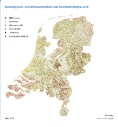
The Biodiversity Monitor can be applied on all ~18k dairy farms in the Netherlands (green dots on map). Source: CBS, 2019.
CONTRACT
Contract conclusion:
Written agreement
Payment mechanism:
Currently: • Higher product price (FrieslandCampina) • Loan interest discount (Rabobank) • Subsidy (Province Drenthe); Other possibilities: • CAP rewards • Favorable land lease conditions • Water tax discount • Etc.
Funding/Payments:
• Market sector (FrieslandCampina and Rabobank) • Government without EU funding (province Drenthe) High potential for government with EU funding (ecoschemes for post 2020 CAP)
Start of the program:
2014 (contracts since 2018)
End:
open end
Feel free to contact us for any further informations.
CONTACT USLegal notice: The compilation of the information provided in the factsheets has been done to our best knowledge. Neither the authors nor the contact persons of the presented cases may be held responsible for the use which may be made of the information contained therein.